01
Zero at genesis
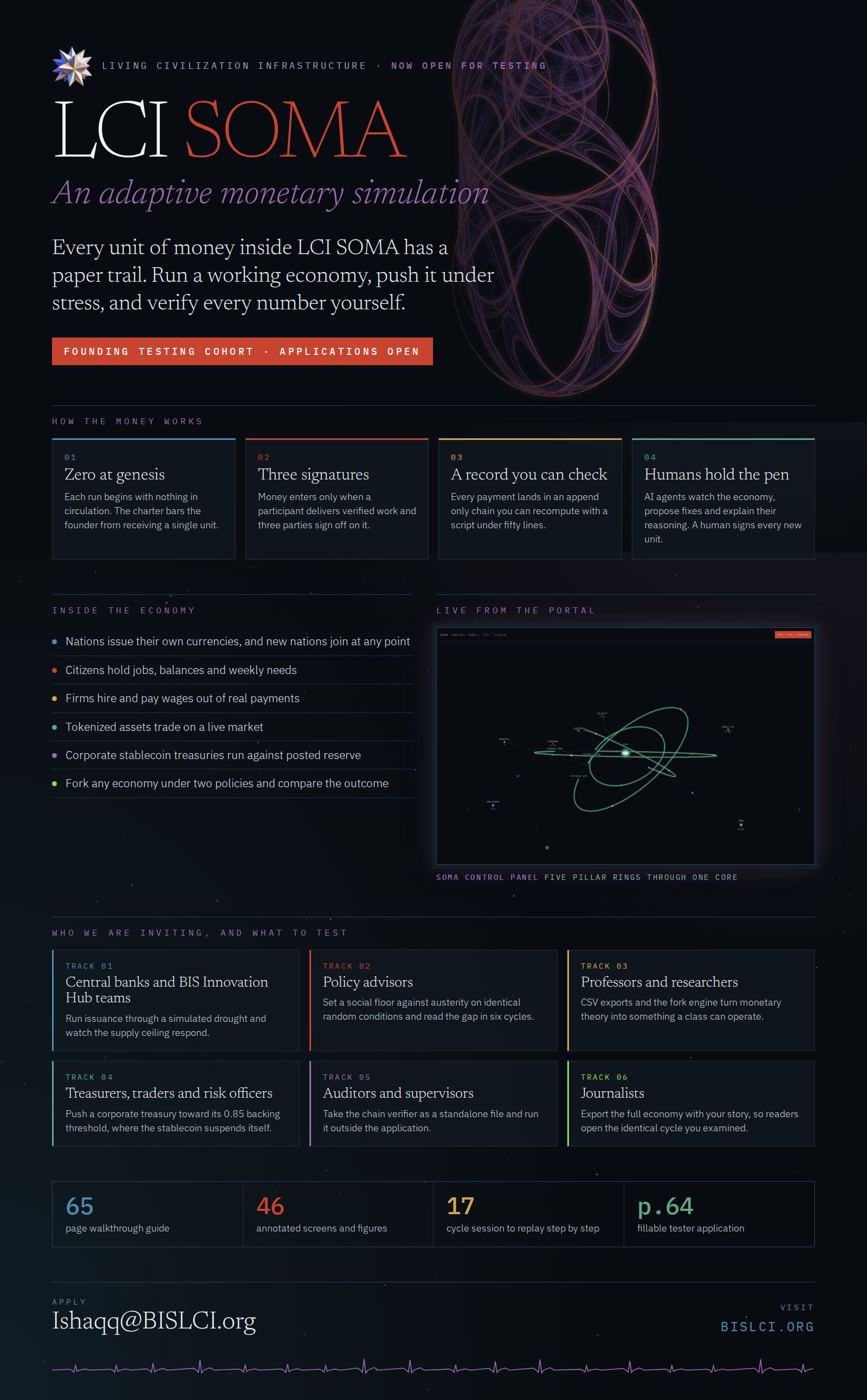
Each run begins with nothing in circulation. The charter bars the founder from receiving a single unit.

Living Civilization Infrastructure · Now open for testing
An adaptive monetary simulation
Every unit of money inside LCI SOMA has a paper trail. Run a working economy, push it under stress, and verify every number yourself.
How the money works
01
Each run begins with nothing in circulation. The charter bars the founder from receiving a single unit.
02
Money enters only when a participant delivers verified work and three parties sign off on it.
03
Every payment lands in an append only chain you can recompute with a script under fifty lines.
04
AI agents watch the economy, propose fixes and explain their reasoning. A human signs every new unit.
Inside the economy
Live from the portal
Soma control · cycle 17
Live
Composite index · four readings per cycle, drawn as a single line
Who we are inviting, and what to test
Track 01
Run issuance through a simulated drought and watch the supply ceiling respond.
Track 02
Set a social floor against austerity on identical random conditions and read the gap in six cycles.
Track 03
CSV exports and the fork engine turn monetary theory into something a class can operate.
Track 04
Push a corporate treasury toward its 0.85 backing threshold, where the stablecoin suspends itself.
Track 05
Take the chain verifier as a standalone file and run it outside the application.
Track 06
Export the full economy with your story, so readers open the identical cycle you examined.
The simulation lets institutions, researchers and reporters run a working economy, push it under stress, and verify every unit of money on their own.
Every unit of money inside LCI SOMA has a paper trail.
The adaptive monetary simulation, built by founder Ishaqq Yorakee Ramesses Rahim, begins each run with nothing in circulation. Money enters the system only when a participant delivers verified work and three parties sign off on it. Every payment lands in an append only record that anyone can recompute with a verification script shorter than fifty lines. The project's charter bars the founder from receiving a single unit.
Today the platform opens to a founding cohort of outside testers.
LCI SOMA treats an economy the way a physician treats a living body. Four readings are taken every cycle: coordination, liquidity, foresight and trust. They combine into a single composite score, drawn across the top of the screen as a heartbeat.
AI agents watch the whole system. They forecast the next cycle, flag shortages, propose fixes and explain their reasoning in plain language. Their authority ends at the signature line: a named human approves every new unit of money before it exists.
On screen, the simulation behaves like a small world economy.
Nations issue their own currencies, and new nations can be admitted at any point. Citizens hold jobs, balances and weekly needs. Firms hire, pay wages and earn their margin out of real payments. Tokenized assets trade on a live market, and corporate stablecoin treasuries operate against reserve their issuers actually post.
Shocks arrive on demand: droughts, demand surges, trust breaches, liquidity freezes. A counterfactual engine runs the same economy twice under two different policies, using identical random conditions, so any gap between the results comes from the policy alone.
The invitation is tailored to each profession.
Central banks and BIS Innovation Hub teams are asked to run issuance through a simulated drought and observe how the supply ceiling responds.
Policy advisors can set a social safety floor against austerity under identical conditions and read the difference within six cycles.
Professors and researchers gain CSV exports and a fork engine that turn monetary theory into something a class can operate directly.
Treasurers, traders and risk officers are invited to push a corporate treasury toward its 0.85 backing threshold, the level at which the stablecoin suspends itself automatically.
Auditors and supervisors receive the chain verifier as a standalone file to run outside the application.
Journalists can export the full state of the economy alongside a story, so readers open the identical cycle the reporter examined.
A 65 page walkthrough guide accompanies the launch. It documents every screen and visualizer across 46 annotated figures and reconstructs a seventeen cycle test session step by step. It closes with three timed test scripts, a feedback rubric and a fillable application on page 64.
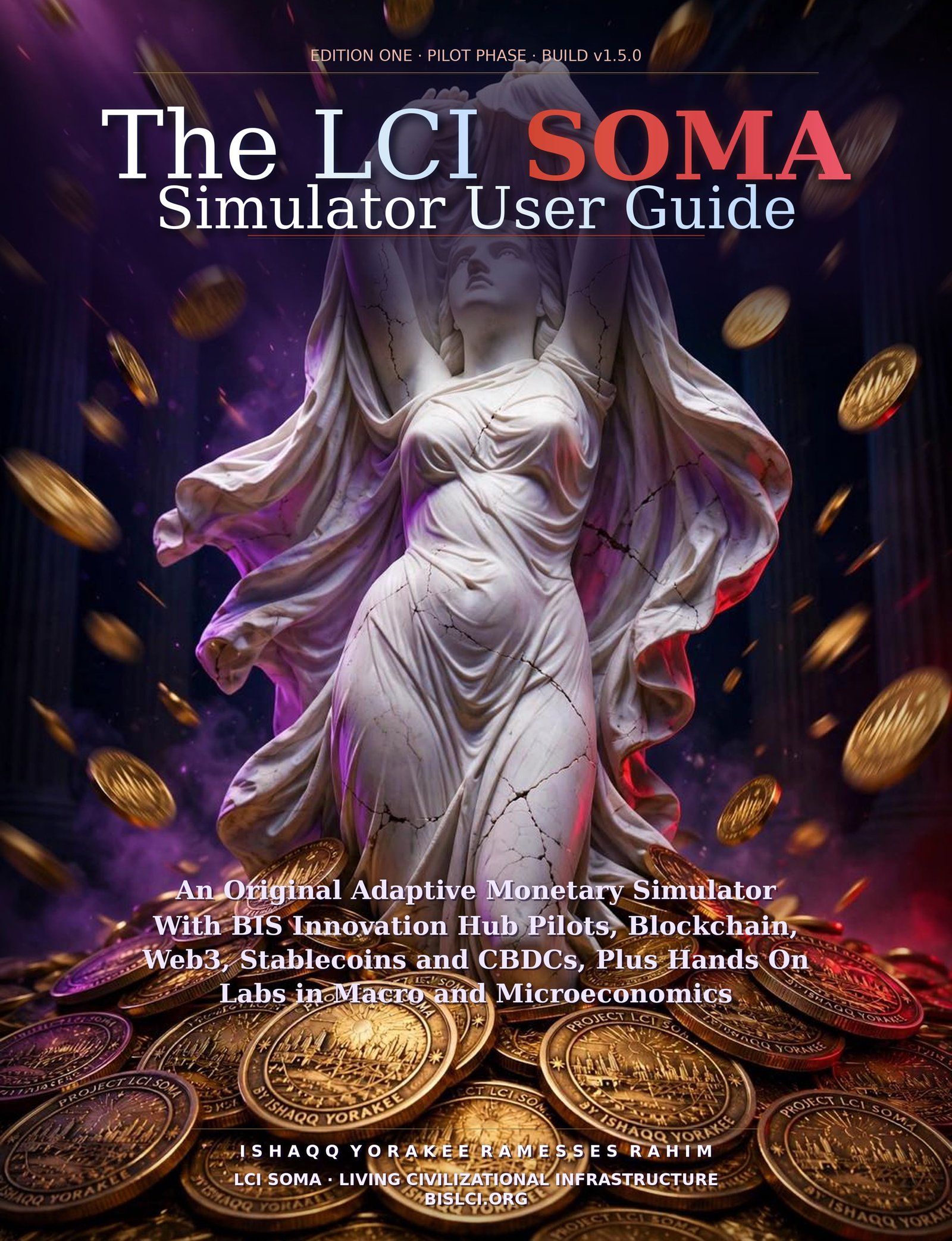
Edition One · Pilot Phase · Build v1.5.0
The full current Simulator Guide Book is now available on Amazon in Kindle and paperback. It is the complete user guide to the adaptive monetary simulator, covering BIS Innovation Hub pilots, blockchain, Web3, stablecoins, CBDCs, and hands-on labs in macro and microeconomics.
This book is more extensive than the 65-page walkthrough guide. The walkthrough remains the practical entry for testers. The Simulator Guide Book is the fuller reference.
Ishaqq Yorakee Ramesses Rahim · LCI SOMA · BISLCI.org
Download the guide, complete the application on page 64 in any PDF reader, and email it to Ishaqq@BISLCI.org. Testers choose a session length: a thirty minute first look, a ninety minute stress test, or a half day audit. Findings stay private unless the tester gives permission to quote them.
Apply by Email“I developed a methodology, accumulated evidence, created a specialized research environment,” Rahim writes in the project charter, “and can use it to answer questions other people care about.”
His request to testers is simpler. The findings he values above all are the ones where something breaks.
LCI SOMA is a demonstration environment with zero live value. Every citizen is a simulated agent and every figure is simulation output.
Continue to the simulator or the homepage invitation.
Apply
Ishaqq@BISLCI.org
Visit
BISLCI.ORG